Posts about Life

Spooky Consistency! 🎃🎃

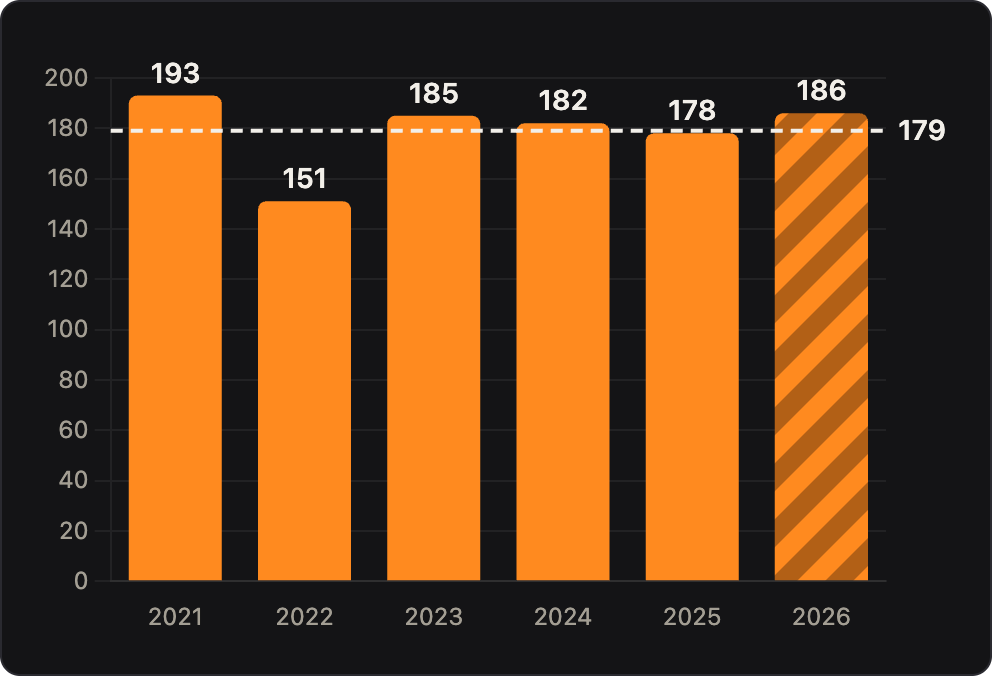
Chart of Halloween trick-or-treaters after COVID

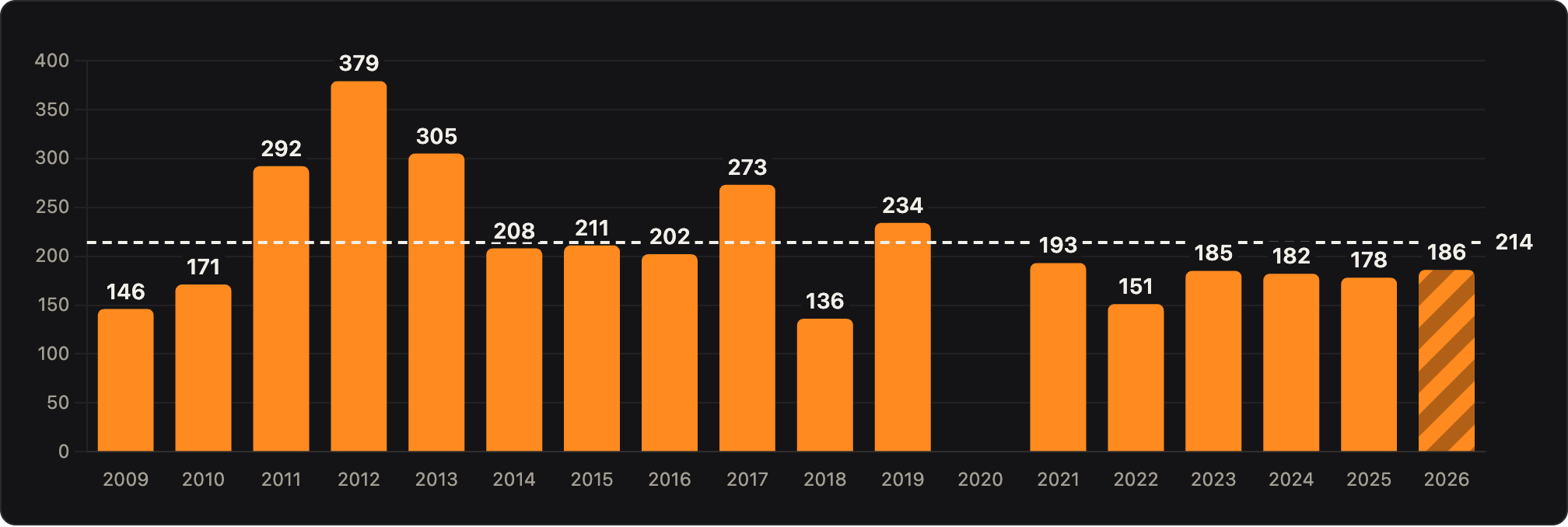
Halloween 2026 is in the books now. We had 186 trick-or-treaters on Saturday night. A very respectable showing and a lovely evening.

What's surprising to me, year over year, is how consistent our count is, at least for the past six years. It's not like it's always the same families, or that our neighborhood is stuck. We're seeing a ton of new young families in The Willows, which makes it all the more surprising that it doesn't move the numbers much.

Well, at least since COVID. We did have some banner years, including about 2x our current amount in the nutty year of 2012. That year was nuts. This is the whole history so far.

Chart of Halloween trick-or-treaters every year since 2009, averaging 214

New This Year: Live Tracking!

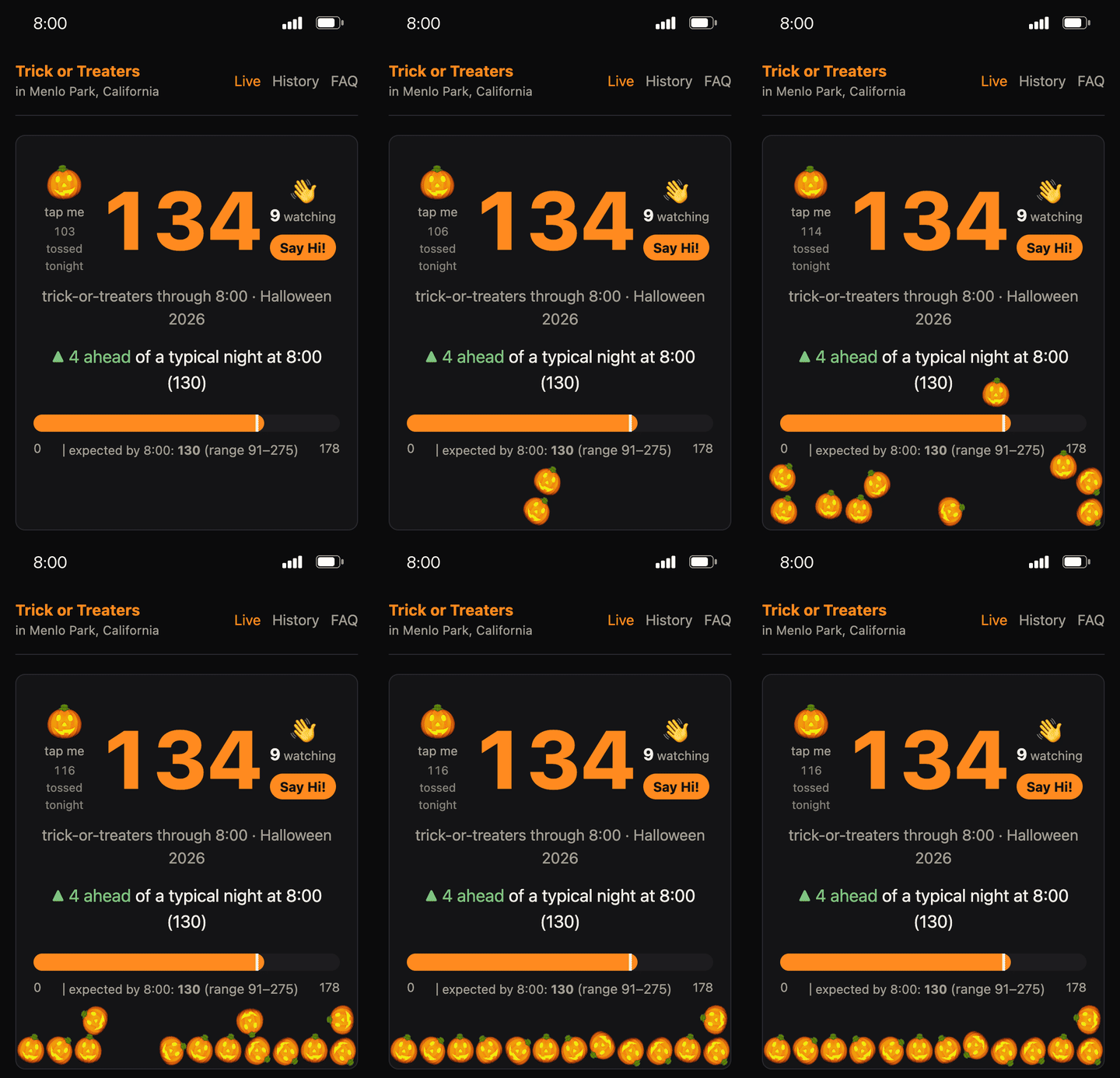
The big new thing this year was an app. You can try it out for yourself at halloween.kloninger.com. What you see if you go there now are some charts showing trends, but during the night-of, when we were doing the count, the live page was up showing the current tally. People have been asking me for that for years.

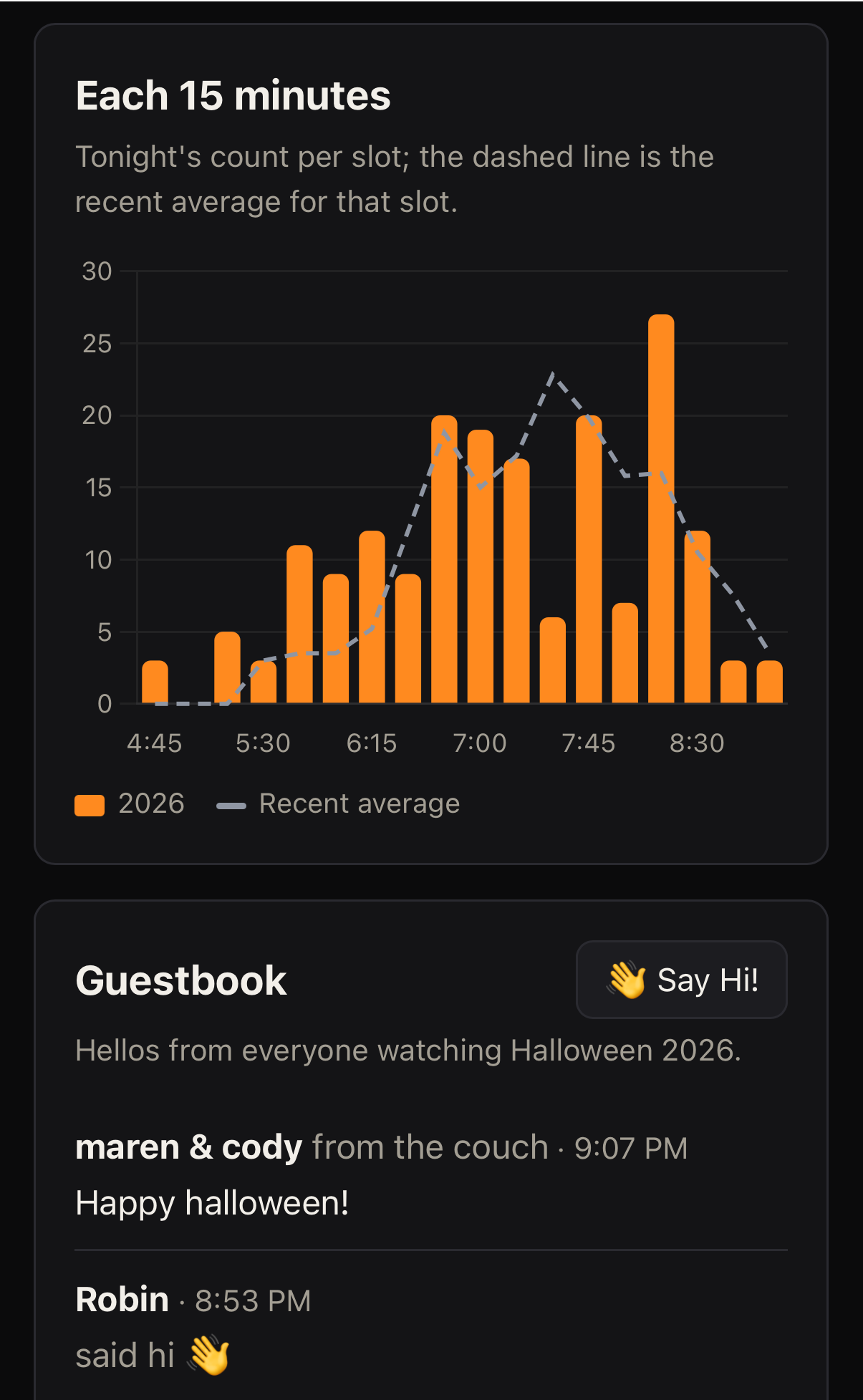
Here are a couple of screenshots of what it looked like on mobile. The guestbook and little "throwing pumpkins" interaction was fun.

Animation: jack-o-lanterns tossed onto the live page at 8pm on Halloween night, piling up at the bottomThe live page later that night: trick-or-treaters each 15 minutes, and the guestbook

There are a bunch of other charts up there too. I especially like the heat map, check that out.

I don't plan on maintaining the old Google Spreadsheet version anymore. It had a good run, but this is way more fun.

Data Is Worth Preserving

Logo for the Data Rescue Project

Governments should produce public goods, like navigation aids and roads. That seems like a reasonable thing to expect of a functioning government, right?

I consider data a public good too. We all benefit from accurate maps, thorough measurements of the natural world, and trustworthy economic data.

Which is why I was so upset when I heard how the current US administration has been on a tear to actually remove data. All through 2025, websites were taking down and datasets were taken offline. This Wikipedia page catalogs what's been happening, and this report by the American Statistical Association goes into more depth about what's been happening and its implications.

In response the Data Rescue Project sprang into action. They're a group of concerned academics, librarians, and citizens who have been copying and cataloging datasets so they aren't lost. The project's press page has links to many articles and presentations that describe their work and its impact. Last November I saw a call for volunteers for DRP on a mailing list of ex-Googlers and was eager to help.

Homeland Infrastructure Foundation-Level Data (HIFLD)

It's worth describing a bit about the particular dataset I actually worked on: Homeland Infrastructure Foundation-Level Data (HIFLD). It's a good case study.

HIFLD is a collection of maps. Maps of basic stuff, like roads, levees, river depth charts, locations of military bases. Beyond just being good maps, a big part of HIFLD's value is helping to make sure everyone uses the same maps.

So HIFLD is mostly curating data. Most of the data comes from other agencies (USGS, Army Corps of Engineers, Census Bureau) and HIFLD brings it together and provides it in a trustworthy, central place. Well, I should say "provided" because in September the government stopped providing it. The story is well told in this good article on Project Geospatial.

This is where the Data Rescue Project comes in. DRP volunteers immediately scooped up the data and kept in temporary storage. Then they organized a bucket brigade of volunteers to categorize and put snapshots into long-term storage. Importantly, this was coupled with metadata to ensure they're findable later. That's the part I worked on, uploading and entering metadata. We met our goal of getting all of HIFLD "rescued" by year's end. Frank Donnelly, the project manager, wrote up a nice summary of what we did and how. For my piece I relied on a nice Selenium driver, written by another volunteer, to create over a hundred projects (screen recording).

This is just one of many DRP efforts. Check out their tracker to see the breadth of work.

While I'm proud of this project, I keep reminding myself that we're playing defense. Having a one-time snapshot isn't nearly as good as having the government actually do its job. Which is why we need to keep demanding better leadership and a return to effective government. Assert your rights and protest!   ❌ 👑.


Post-Publish Updates

I'll update this section from time to time with updates and press on this project.

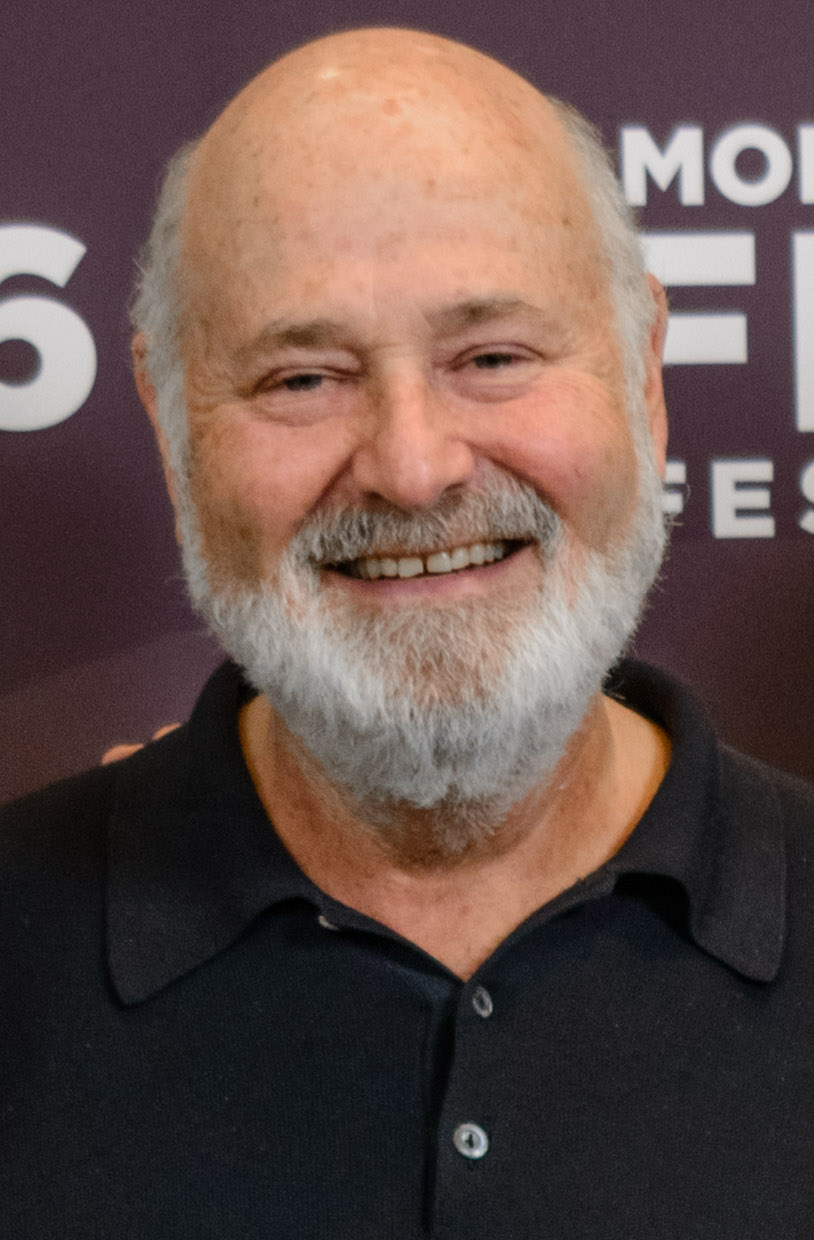
Rob Reiner: "Whatever you like to do, do a lot of it. Do it every day."

Photo of Rob Reiner from Wikipedia, source Neil Grabowsky / Montclair Film Festival

I was fortunate to have met and shared a meal with Rob Reiner some years back. I wanted to take a moment to share this story on the sad occasion of his death this week.

It was 2003 or so. I lived and worked for Akamai in Boston. I had been going back and forth to San Mateo office a fair bit that year, often taking a red eye home from San Jose. Back then the San Jose airport was smaller than it is now, and was especially quiet at the evenings. Not a lot of dinner options, so McDonald's it was.

That day I was surprised to recognize Rob Reiner in line right in front of me! He was traveling with some assistant-type person, patiently waiting. I tend to not bother celebrities in public, but I was moved to say something.

Sef: Hello Mr. Reiner. Forgive me but I just wanted to say how much I enjoy your work. I'm a really big fan.

Rob Reiner (big grin): Hi! What's your name? Thanks for introducing yourself. What have I done that you like?

I think he genuinely wanted to know. I knew his big films pretty well — When Harry Met Sally was the most popular, A Few Good Men had been up for Best Picture, Spinal Tap is well, Spinal Tap. These are all really great films.

Sef: The Princess Bride, hands down. I love the story and I love what you did with it.

Rob Reiner: I'm glad you said that. That's my favorite too.

Hearing that was more than I'd hoped for. I thanked him and begged off so he could order his burger and have dinner in peace. But no, in that New Yorker voice and with a big smile he said, "C'mon, let's have cheeseburgers!" The three of us all sat.

We had a nice talk over dinner. He asked questions and seemed genuinely interested in what I did -- work, family. But the highlight was toward the end.

Rob Reiner: What else can I answer for you?

Sef: What would you tell someone early in their career?

At this point I was about thirty years old, so hardly that early in my own career, but I was asking in a genuine way. He answered straight away.

Rob Reiner: Whatever you like to do, do a lot of it. Do it every day. Me, I like writing so I try to do that of it every day if I can. That's how you get good.

He then told a few stories about people he'd met who don't do this. I guess when you're someone like him, people ask you frequently for jobs or if you'd produce their movie or whatnot. He said he asks what was the last thing they'd written, or what they were working on now, or what'd they'd written today. And he could tell if they did it often and did it for fun. If they didn't do it often, then how good a writer were they likely to be?

I was struck by what a nice and interesting, and interested, person Rob Reiner was. It was incredibly generous for him to spend time with a fanboy when he could be off duty and just enjoying his cheeseburger. What a gem.
Three Months

I've been off work for about three months now. It's a good occasion to take stock of how that's going. In a word, it's been great.

Meme from the movie \

  • I'm surprised how much lighter my mood is. It feels like a weight that I've been carrying around for some time is no longer there. It's different than being on vacation, better actually. I didn't appreciate how stressful tech management has been all these years.

  • I'm taking a ton of pleasure in simple things. I go grocery shopping almost every day, I'm doing a ton of cooking.

  • It feels good to get healthier. I had knee surgery and am recovering from that just fine. I exercise nearly every day. On days that I don't go to the gym I do thirty minutes on the bike.

  • It's great to have flexibility. I hadn't planned to see my Dad on his 80th birthday because we'd on a bigger group thing later. But on a whim I drove down and took him out for breakfast on his actual birthday, because why not.

  • If I didn't want to do it before, I still don't want to do it. The closet hasn't gotten cleaned out; neither has the garage.

My friend Rachel Grey has a three month head start leaving Google. Her writing this resonates with me. Especially this from a recent LinkedIn post (private, sorry): "one month off per year of service is a good rule of thumb; after six of them, I'm still feeling like a sailor who just barely managed to swim to shore." Maybe that's still where I'm at too.

So what have I been doing? I'm prioritizing friends and family — I'm lucky to have a lot of people I care about. I'm embarrassed that I haven't always been good about staying in touch, but I can fix that now. And fun stuff like bridge lessons.

Beyond that, I'm getting involved with a couple of small projects but nothing serious yet. When I find something interesting, I'll write about it here.

Leaving Google

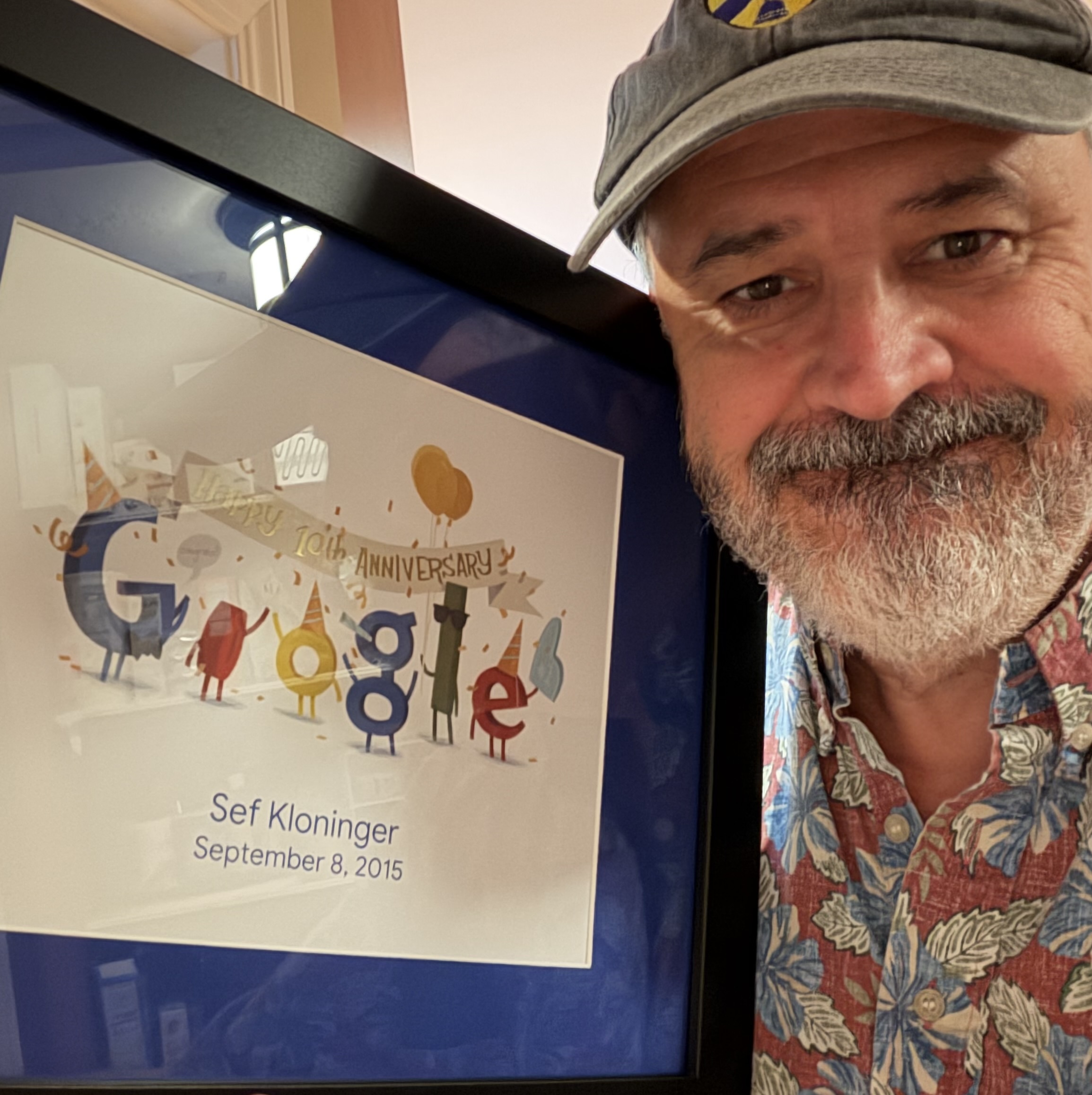
Sef holding a framed certificate, Google ten years of service.

An offer of a Voluntary Exit from Google HR landed in my mailbox right around my ten-year anniversary with the company, give or take. We'd had a couple of packages like this at Google before (news), basically the same deal you'd get if you got laid off. But this was the first one put in front of those of us working in one of the revenue engines of the company — I worked on Search.

I wasn't aiming to leave. I liked the work, I had a good team and boss. But the package was enough to kickstart a discussion, "why not now?". My wife and I ran numbers and discussed our futures. I clicked the button. My last day as a Googler was earlier this week, October 4th.

I have good feelings about my time at Google. It was nice that I saw a some different parts of the business: some consumer (three years at YouTube, four years at Search) and some enterprise (three years at Cloud). I got to play with big infrastructure and solve some hard problems. I saw behind the curtain. But the best part was the smart and interesting people I got to work with. I know it's a cliche, but it's the truth.

Not everything was great. I've decided to not use this space for dishy stories about how Google isn't all it claims to be. But I sure do love reminiscing and grousing as much as any engineer. If you want to share war stories over a beer, I'm always up for that.

What's next? I haven't decided if this is retirement, or a sabbatical, or something else. I've been off work for extended stretches twice before, once by choice and once not. Those two times taught me that the difference between a wonderful, mind-expanding time and a stress-fest is my own mindset. And now that I haven't been really working for six weeks now, I can confidently say that my mindset is positive and good.

I'm excited about the next phase. I feel fortunate to have some time to focus on what's important.

Working In The Open

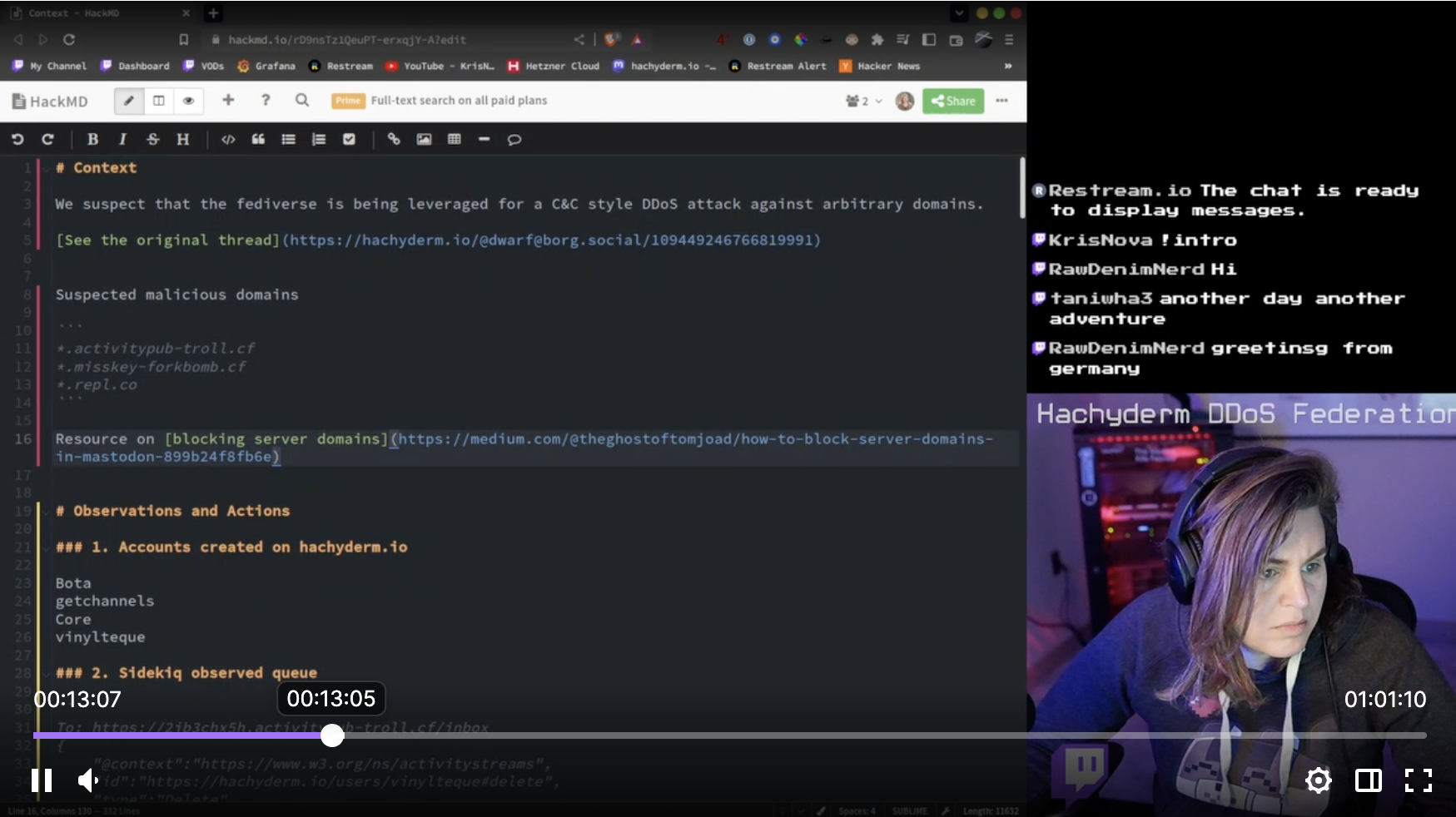
screenshot of @nova live-debugging Hachyderm on Twitch

The other day my daughter asked me about Software Engineering -- what do we actually do? She's eighteen and probably won't follow in my footsteps, which is fine, but I still want her to see my field.

I've always found this question hard to answer. I've been an engineering manager for a long time, and I'm happy to describe that job (emails, 1:1's, PRD reviews), but I don't think that's the heart of it. Plus these days I work for Google where things there are proprietary and deeply layered, not much help for answering questions like these.

Recently I've found my way to Mastodon for obvious reasons. I chose the Hachyderm instance because it was well run by people who shared my values. It turns out that the values of the owners and operators of the things we use matter, huh.

I then learned a cool thing, that the Hachyderm admins do much of their work publicly. They livestream debugging sessions on Twitch, they write postmortems, they share live graphs. @nova happened to be live-streaming at that moment, not surprising since the team's been busy absorbing thousands of new users and fending off attacks. My daughter and I watched a bit together.

Team Hachyderm (@nova @dma @quintessence @Taniwha @hazelweakly @malte): thank you for running this service well. But also thank you for giving me something I'm proud to use and proud to show my kid.

Flat

Trick-or-treaters volume at our Menlo Park house this Halloween was basically flat compared to last year. Last year we had 208 trick-or-treaters, this year 211. We remain down quite a bit from our 2012 peak. Maybe this is the new norm?

Everything happened later this year. Our first trick-or-treater didn't show up until 6:30, and peak wasn't until 8:45. That's thirty minutes or more later than prior years. I speculate it's because it was a warm weekend night. Why not stay out a bit later, no school tomorrow. And with the fall-back DST change everyone would be looking forward to a "free" hour of sleep.

As usual, the full story can be seen in the numbers. Check it out!

YouTube

YouTube

I'm excited to start my new job at YouTube in a few weeks. I'll manage the engineering team building the data warehouse for usage metrics.

I like that YouTube is important. It's firmly a part of our culture and I'm sure it will be how my kids watch video. YouTube's impressive statistics are the result. You don't see usage like that without a bunch of hard problems, and hard problems attract bright people. Indeed that's the clincher for why I'm looking forward to working there. People vote with their feet, and I have a lot of friends who have opted for Google, and YouTube specifically. They tell me that it's a great place to work.

YouTube is one of the world's foremost platforms for social commentary, education, and free speech. And it's plenty of entertainment too. Sounds like fun.